
Best lens for wildlife photography
Choose a native long zoom for changing wildlife distance. Extra reach helps only when the animal, light and carrying plan suit it; a fixed 600mm is a specialist.

For daylight wildlife with changing distance, start with the native long zoom that fits your camera: Canon RF100-500mm F4.5-7.1 L IS USM, Sony FE 200-600mm F5.6-6.3 G OSS SEL200600G or Nikon NIKKOR Z 180-600mm f/5.6-6.3 VR. Canon owners needing still more range can consider the RF200-800mm, with f/9 at the long end as a clear trade. Nikon’s 100-400mm favors a shorter range, while Canon’s fixed 600mm f/4 is a specialist for distant subjects rather than a universal upgrade.
Choose for the animal and the walk. A long lens can frame a distant bird but leave no room for a nearby mammal. Weight and the available light matter too. A smaller maximum aperture lets in less light, which can limit shutter-speed choices as the light fades. Plan support and check tracking, weather protection and converter compatibility for your exact kit. Keep a respectful distance from wildlife rather than disturbing an animal to fill the frame.
These recommendations draw on manufacturer specifications and independent reviews. Framing advice is editorial; sources are collected at the end.
We may earn a commission from qualifying purchases through the Amazon.com links. They open exact-model searches, not verified listings. Check model, mount, generation, condition, accessories, seller authorization, price, regional warranty and delivery date before ordering. Stock and worldwide shipping are unverified, and Amazon.com may not deliver to your country.
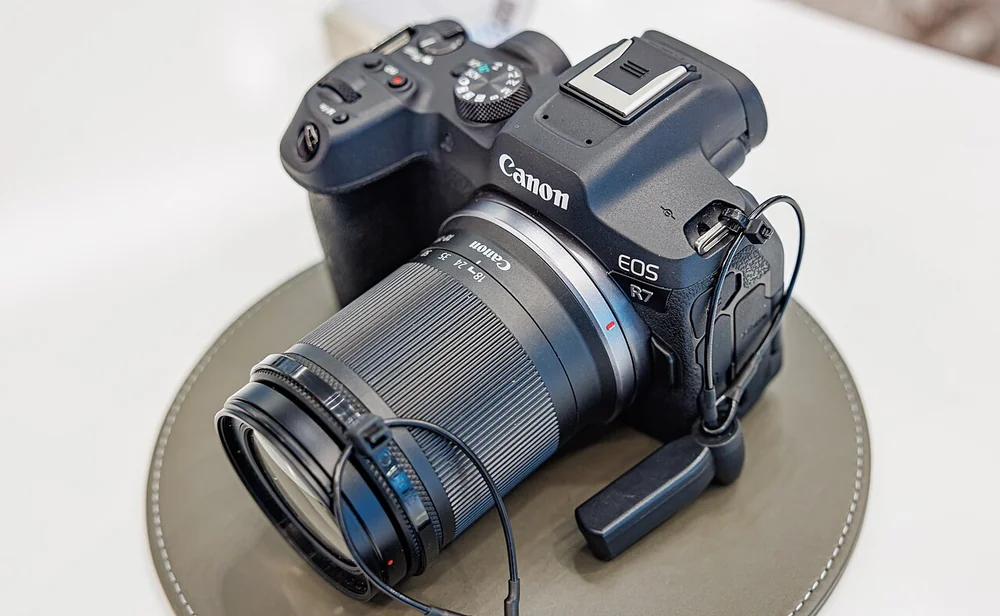
The featured Canon EOS R7 photograph is a camera-system illustration, not one of the seven lens picks. Any pictured camera, lens or accessories are not included in these recommendations.
For a separate body decision, the sports camera guide covers moving-subject priorities, not a verified bird-tracking result for these lens combinations. If your wildlife trips involve long walks, use the travel camera guide to consider the rest of the kit; a compact body does not remove a long lens’s carrying burden.
Compare the seven picks
| Exact product and affiliate search | Native mount and coverage | Focal length | Maximum aperture | Best-fit job |
|---|---|---|---|---|
| Canon RF100-500mm F4.5-7.1 L IS USM | Canon RF, full frame | 100-500mm | f/4.5-7.1 | Canon versatile daylight long zoom |
| Canon RF200-800mm F6.3-9 IS USM | Canon RF, full frame | 200-800mm | f/6.3-9 | Canon extra-reach daylight zoom |
| Canon RF100-400mm F5.6-8 IS USM | Canon RF, full frame | 100-400mm | f/5.6-8 | Canon shorter daylight compromise |
| Sony FE 200-600mm F5.6-6.3 G OSS SEL200600G | Sony E, full frame FE | 200-600mm | f/5.6-6.3 | Sony E daylight long zoom |
| Nikon NIKKOR Z 180-600mm f/5.6-6.3 VR | Nikon Z, full frame FX | 180-600mm | f/5.6-6.3 | Nikon Z daylight long zoom |
| Nikon NIKKOR Z 100-400mm f/4.5-5.6 VR S | Nikon Z, full frame FX | 100-400mm | f/4.5-5.6 | Nikon shorter wildlife range |
| Canon RF600mm F4 L IS USM | Canon RF, full frame | 600mm | f/4 | Canon fixed distant-subject specialist |
Check your mount and sensor first
Canon RF lenses cover full frame and give a narrower view on RF APS-C. They do not fit EF DSLRs or EOS M. EF-to-RF adapters do not work in reverse.
Sony E entries cover FE full frame and give a narrower view on E APS-C. A-mount is excluded.
Nikon Z lenses cover FX and give a narrower view on Z DX. They are not F DSLR lenses. FTZ does not adapt Z lenses to F bodies.
No adapted use or teleconverter combination is verified. Physical focal length and f-number do not become sensor-equivalent values. Native fit is not an exhaustive body or firmware approval.
Which lens fits your job?
1. Canon RF100-500mm F4.5-7.1 L IS USM
Product photo loads from Amazon when available.
Choose the RF100-500mm for changing wildlife distance when 500mm is enough. The 100mm wide end gives you more room for closer animals than a zoom starting at 200mm.
At the long end, f/7.1 limits low-light action, so think about dawn conditions as well as reach. Cameralabs also notes that its aperture does not give the shallowest depth of field, the zone that appears sharp around the subject.
2. Canon RF200-800mm F6.3-9 IS USM
Product photo loads from Amazon when available.
The RF200-800mm is for more distant daylight subjects when 500mm is not enough. You can adjust framing rather than commit to a fixed 800mm view.
There are two important limits at 800mm. The maximum aperture is f/9, restrictive in low light, and Digital Camera World reports some loss of sharpness there. At the other end, 200mm can still be too tight for an animal nearby.
3. Canon RF100-400mm F5.6-8 IS USM
Product photo loads from Amazon when available.
Choose the RF100-400mm for nearby larger animals when you do not need more reach. If distant birds remain tiny in your current 400mm pictures, this range will not solve that framing problem.
The f/8 maximum aperture at 400mm makes it a daylight-oriented action choice. Digital Camera World reports no weather seals, so plan for exposed conditions. Check current pricing rather than assuming it is the cheapest option.
4. Sony FE 200-600mm F5.6-6.3 G OSS SEL200600G
Product photo loads from Amazon when available.
The Sony 200-600mm gives E-mount owners adjustable long framing for daylight wildlife. Sony lists its weight at 2115g, over 2kg, so decide how you will carry and support it.
At 600mm, f/6.3 limits shutter-speed choices in dim light. Dawn photographs are still possible depending on the setup, but stabilization cannot freeze animal motion. The 200mm wide end also leaves less room for nearby subjects.
5. Nikon NIKKOR Z 180-600mm f/5.6-6.3 VR
Product photo loads from Amazon when available.
Choose the Nikon Z180-600mm when distant animals change position and you need both reach and zoom flexibility. Its f/6.3 long-end aperture limits dim-light action, so evaluate the native range and light before adding accessories.
Nikon warns that autofocus may fail or focus indicators may flicker with teleconverters in some conditions. Verify the exact lens, converter and body combination; no converter setup is recommended here.
6. Nikon NIKKOR Z 100-400mm f/4.5-5.6 VR S
Product photo loads from Amazon when available.
The Nikon Z100-400mm is worth choosing for closer animals when you do not need 600mm. It starts wider than the 180-600mm and offers f/5.6 at 400mm. For nearby larger animals, that shorter range can be more useful than maximum reach.
Nikon lists it at 1355g, and Photography Life describes it as large and heavy. It is not a tiny walking lens. You also give up the last 200mm of reach compared with the 600mm zoom alternatives.
7. Canon RF600mm F4 L IS USM
Product photo loads from Amazon when available.
Choose the RF600mm f/4 for a repeatable distant subject when the smaller apertures of the long zooms limit your exposure choices. You need space to track the animal and a subject distance that suits fixed 600mm framing. It cannot widen when the animal comes close.
For occasional specialist use, consider renting. Digital Camera World suggests that may be more viable for non-professionals than buying the prime.
Buying criteria
Identify the subject and distance
Small distant birds often need more reach than large animals nearby. Review your existing photographs to see whether cropping is the main limitation. A zoom with a shorter wide end can help when an animal approaches unexpectedly. Fixed 600mm makes more sense for a repeatable distant subject than for every encounter on a varied walk.
Decide when you actually photograph wildlife
Daylight and dawn place different demands on aperture. The long zooms have smaller maximum apertures at their long ends; the Canon 600mm opens to f/4. The wider aperture gives you another exposure option, although no low-light success rate has been measured here. Stabilization cannot freeze wings or a running animal. Check your camera and the available light rather than assuming all long lenses behave the same at sunrise.
Make carrying and support part of selection
Sony lists the 200-600mm at 2115g; Nikon lists the 100-400mm at 1355g. Those figures are useful starting points, not a weight ranking of all seven picks. Check the other exact-model specifications before choosing a bag or support, then consider how far you will walk with the whole kit. There is little value in reach you cannot comfortably bring along.
Verify weather and accessory claims
Digital Camera World reports no weather seals on the Canon 100-400mm. Check weather protection separately for the other lenses rather than assuming it across the list. Nikon’s 180-600mm teleconverter autofocus warning also deserves attention, and Canon extender restrictions need their own exact-model checks. No converter combination is approved here.
Maintain a safe, respectful distance from wildlife. Longer reach is useful for photographing without disrupting the subject.
Frequently asked questions
Is 400mm enough for wildlife?
Sometimes. Nearby larger animals may fit well, while small distant birds may require heavy cropping. Choose based on your usual subject and access rather than a universal minimum. The 100-400mm entries remain useful alternatives when a longer lens would be unnecessarily tight.
Is the 800mm zoom always the best bird choice?
No. The Canon 200-800mm offers reach, but at 800mm its maximum aperture is f/9 and Digital Camera World reports a sharpness drop. Light, support and the animal’s distance matter. Its 200mm wide end can also be restrictive for nearby subjects.
Can a crop body add optical magnification?
A compatible APS-C body records a narrower view, but it does not change the physical focal length of these full-frame lenses. That may help framing, while body performance and image requirements still matter. It does not establish a converter or an automatic image-quality improvement.
Should I buy a teleconverter immediately?
Decide whether the native range solves your framing problem first. Before buying a converter, check the exact lens, converter and body, including restrictions and autofocus warnings. Nikon explicitly warns of possible focus problems in some conditions with the 180-600mm.
Sources and specifications
- Canon RF100-500mm F4.5-7.1 L IS USM: Canon specifications, Cameralabs review.
- Canon RF200-800mm F6.3-9 IS USM: Canon specifications, Digital Camera World review.
- Canon RF100-400mm F5.6-8 IS USM: Canon specifications, Digital Camera World review.
- Sony FE 200-600mm F5.6-6.3 G OSS SEL200600G: Sony specifications, Photography Life review.
- Nikon NIKKOR Z 180-600mm f/5.6-6.3 VR: Nikon specifications and converter warning, Digital Camera World review.
- Nikon NIKKOR Z 100-400mm f/4.5-5.6 VR S: Nikon specifications, Photography Life review.
- Canon RF600mm F4 L IS USM: Canon specifications, Digital Camera World review.
Related guides
Best lens for wedding photography
Compare seven Canon RF, Nikon Z and Sony E wedding lenses for general coverage, distant ceremonies and environmental portraits.
Best lens for macro photography
Compare seven native-mount macro lenses reaching at least 1:1, with sensor coverage, stabilization caveats and body-specific focus-stacking limits.
Best lens for food photography
Compare seven Canon RF, Nikon Z and Sony E food lenses for tabletop framing, overhead space and macro detail, with sourced tradeoffs.